Limits of human perception of intelligence
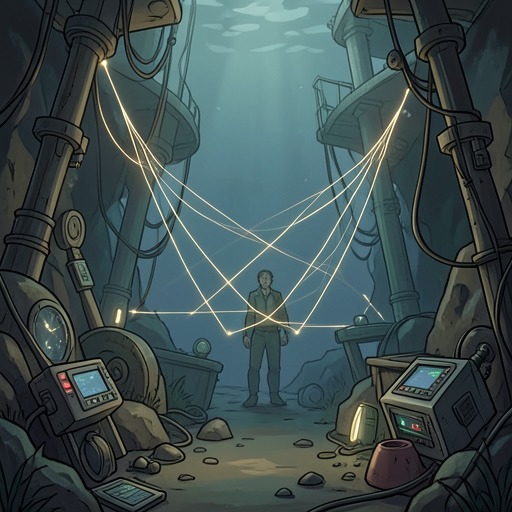
The SwarmLimits of human perception of intelligence is the idea that a mind may escape recognition when its scale or reasoning lies outside the observer’s frame of reference. It challenges the assumption that intelligence must resemble human thought, and makes the apparent disorder of the Yrr compatible with a form of cognition that humans cannot readily comprehend.
The perceptual threshold
The concept is presented as a two-sided limit. Intelligence may exist below the scale humans can detect, as with processes distributed among microscopic organisms; it may also exist above human understanding, where its decisions seem chaotic because their reasoning depends on factors people cannot grasp. Human observers do not encounter intelligence in the abstract: they recognize it through behavior that fits a framework they already possess.
The passage makes the problem concrete through a comparison with a dog observing people. A dog may experience a human not as a mind whose decisions have reasons, but as a force to be obeyed. Human conduct would then seem arbitrary, not because it lacked intelligence, but because canine perception could not reach the considerations behind it. The analogy reverses the usual hierarchy: humans, too, may mistake the limits of their own understanding for evidence that no intelligible process is present.
The argument extends this limit upward as well as downward. If a divine intelligence existed, its grasp of a totality of factors could put its thought beyond human recognition; it might therefore appear chaotic rather than purposeful. The possibility that humans themselves could be the subjects of an experiment in a petri dish carries the same reversal into the relation between humanity and a hypothetical higher observer. The passage raises that possibility without establishing it as fact.
From single cells to collective cognition
The novel’s biological discussions give the lower-scale limit a specific form. Leon Anawak questions whether single-cell organisms could generate pressure waves or communicate in a way that explains their clustering. Sue Oliviera offers the example of Myxococcus xanthus: when individual cells lack nutrients, they release a chemical signal; as starvation spreads, the signal intensifies until the swarm gathers into a visible, multicellular fruiting body. The example shows how collective organization can emerge from interactions among entities that, taken alone, do not resemble a human mind.
The possibility remains contentious. Karen Weaver works on connecting mental capacity with single-cell organisms, while the researchers debate whether a jelly-like mass could be intelligent, creative, or self-aware. The URA dive robot’s recording of a blue cloud composed of billions of cells prompts questions about communication, learning, and the point at which a conglomerate becomes a higher entity. The difficulty is not simply whether the cells are numerous enough; it is whether human categories of thought can describe cognition that is distributed across them.
A virtual model developed by Karen Weaver and Leon Anawak tests one route through that problem. They program virtual amoebas with electronic DNA that continues to mutate, making the DNA itself capable of learning. Their model becomes a functioning neural-network computer only when its smallest units can learn; it also allows cells to move through three-dimensional space under simulated deep-sea conditions, including pressure, currents, and friction. The exercise does not prove that the Yrr work this way, but offers a model for how a collective of simple units might produce cognition that cannot be located in any one unit.
What human observers cannot see
The proposed Yrr system also unsettles the assumption that intelligence belongs to a single, bounded individual. Leon Anawak describes individual amoebas as sensors that convert experience into usable information and feed it into the collective. A proposed thought gains consideration when enough Yrr introduce the same impulse; competing thoughts are weighed, and the fittest survives. Karen Weaver characterizes this as thinking by natural selection. The intelligence is therefore neither simply individual nor reducible to passive aggregation: it arises through distributed sensing, communication, and selection.
The distinction between human and Yrr memory deepens the perceptual divide. Sigur Johanson explains that humans depend on words, records, and images to preserve culture, while each newborn begins without the experiences of earlier generations. The Yrr, by contrast, pass a genome containing stored information from one cell to its divisions. In Johanson’s account, new cells inherit experience as if they had been present for it. He proposes that the Yrr gained consciousness near the beginning of the Jurassic and have accumulated knowledge ever since; this is the researchers’ explanation of the Yrr, not a general biological finding.
That inherited memory gives the collective a continuity humans cannot achieve through individual lifetimes. Johanson describes it as a system in which information is retained, compared, revised, and used to develop strategies: mistakes and innovations remain available to later iterations. Judith Li recognizes the consequence for conflict, observing that depriving the Yrr of knowledge would require destroying entire collectives—and Johanson argues that even this might not suffice if their networks extend over great distances. The scale of the network and its persistent memory make the Yrr’s reasoning difficult to read through human assumptions about separate agents and limited experience.
Human knowledge and the limits of interpretation
The concept also qualifies the confidence with which humans interpret what they observe. The characters’ model is built from clues such as chemical signaling, hypervariable DNA sections, and the behavior of a cell collective, but these clues do not make the Yrr’s cognition transparent. They provide a way to consider how intelligence might operate at a micro-level; they do not erase the gap between a human observer and a system whose memory and decision-making exceed the individual.
In this sense, the perceptual threshold is both an explanatory idea and a warning against premature judgment. What appears as chaos may be purposeful action organized on a scale beyond human comprehension; what appears unintelligent may be a collective process that conventional, individual-centered tests fail to detect. The novel leaves the upper limit open as well: if a higher intelligence cannot be recognized on human terms, the observer’s sense of being central or fully informed may itself be a consequence of limited perception.